

Best Coffee Beans for Beginners: A 2026 Buyer's Guide

Table of Contents
- Understanding Coffee Bean Basics: Arabica vs. Robusta for New Drinkers
- Beginner-Friendly Coffee Roasts Explained
-
Top 10 Best Coffee Beans for Beginners: Our Picks
- 1. Eight O'Clock Coffee The Original Medium Roast
- 2. Starbucks Pike Place Roast
- 3. Lifeboost Coffee Medium Roast
- 4. Volcanica Coffee Low Acid Coffee
- 5. Peet's Coffee Major Dickason's Blend
- 6. Lavazza Super Crema Whole Bean Coffee
- 7. Allegro Coffee Organic Espresso Sierra
- 8. Stone Street Coffee Cold Brew Reserve
- 9. Roadway Coffee Mexican Medium Roast
- 10. Brian's Premium Coffee
- Types of Coffee Beans for Beginners: Single-Origin vs. Blends
- How to Choose Coffee Beans: Key Factors Every Beginner Should Know
- Coffee Brewing Methods for Beginners: Matching Beans to Your Equipment
- Sensory Training for Beginners: Learning to Taste Coffee
- Storage Tips to Keep Your Beans Fresh
Best Coffee Beans for Beginners: A 2026 Buyer's Guide
Last Updated: July 27, 2026
Finding the right coffee beans can feel overwhelming when you're just starting out. According to specialty coffee retailers tracking consumer preferences in 2026, nearly 60% of first-time coffee buyers abandon their initial purchases because they don't know what to look for. This guide from Brian's Premium Coffee covers everything you need to understand about choosing the best coffee beans for beginners, from bean varieties to roast levels to storage tips that keep your coffee fresh.
Understanding Coffee Bean Basics: Arabica vs. Robusta for New Drinkers
Two main species of coffee beans dominate the global market: Arabica and Robusta, each with distinct flavor profiles, growing conditions, and price points.
Arabica: The Beginner-Friendly Choice
Arabica beans account for roughly 60-70% of global coffee production and are the default choice for specialty coffee and beginners. These beans grow at higher elevations in cooler climates, allowing complex sugars and acids to develop. The result is nuanced flavors, lower bitterness, and more pronounced acidity that many find approachable.
Arabica beans typically offer flavor notes ranging from fruity and floral to nutty and chocolatey, depending on origin and roast level. They're less dense than Robusta, which means they extract more easily in standard brewing methods like drip coffee makers and French presses. For beginners, Arabica's balanced profile and accessibility make it the logical first choice. The trade-off is cost, Arabica typically runs 50-100% more per pound than Robusta, but for quality-focused beginners, this investment pays dividends.
Robusta: Stronger and More Bitter
Robusta beans are hardier, grow at lower elevations, and produce nearly twice the caffeine of Arabica. They're denser, more bitter, and have a straightforward flavor profile without the complexity of specialty Arabica. Robusta is common in instant coffee, espresso blends, and budget-friendly grocery store brands.
Beginning coffee drinkers often find Robusta too intense or harsh. However, some espresso blends include Robusta for the crema (golden layer on top of espresso) and body it creates. If you prefer bold, no-nonsense coffee without subtle notes, Robusta-heavy blends can work.
Beginner-Friendly Coffee Roasts Explained
The roast level determines how dark the beans are and how heat has transformed the bean's natural sugars and acids. Light, medium, and dark roasts each have distinct characteristics affecting flavor, body, and acidity.
Light Roasts: Bright and Complex
Light roasts are removed from heat before or just as the beans reach their "first crack" (a popping sound signaling expanding gases). This shorter roasting time preserves more of the bean's origin flavors, the terroir from where the coffee was grown.
Light roasts taste bright, acidic, and complex, with fruit, floral, or tea-like notes. They have less body and feel lighter on the palate. For absolute beginners, light roasts can be polarizing, some love the vibrancy, others find the acidity sharp or the flavor profile too unfamiliar. Light roasts work best in pour-over or drip methods where water contact time is moderate.
Medium Roasts: The Safe Starting Point
Medium roasts hit the sweet spot for most beginners. The beans roast past the first crack but before the "second crack," allowing some origin flavors to shine while heat develops deeper caramel and chocolate notes. The result is balanced, neither too bright nor too dark, neither too acidic nor too bitter.
Medium roasts have moderate body and acidity, and they're forgiving across brewing methods. Whether you use a drip machine, French press, or pour-over, medium roasts deliver consistent, approachable flavor with notes of chocolate, nuts, caramel, and subtle fruit. At Brian's Premium Coffee, we emphasize medium roasts for beginners because they work in nearly any brewing setup and rarely disappoint.
Dark Roasts: Bold and Smooth
Dark roasts roast past the second crack, developing a nearly black color and oily surface. Heat dominates the flavor profile, creating bold, smoky tastes with notes of dark chocolate, leather, or burnt caramel. Acidity drops significantly, and body becomes full and heavy.
Dark roasts appeal to coffee drinkers who want a strong, no-nonsense cup that stands up to milk and sugar. They're less acidic, which some find easier on sensitive stomachs. However, the bold character can overwhelm beginners.
| Roast Level | Flavor Profile | Acidity | Body | Best Brewing Method |
|---|---|---|---|---|
| Light | Bright, fruity, complex | High | Light | Pour-over, drip |
| Medium | Balanced, chocolate, nuts | Moderate | Moderate | Any method |
| Dark | Bold, smoky, bitter | Low | Full | French press, espresso |
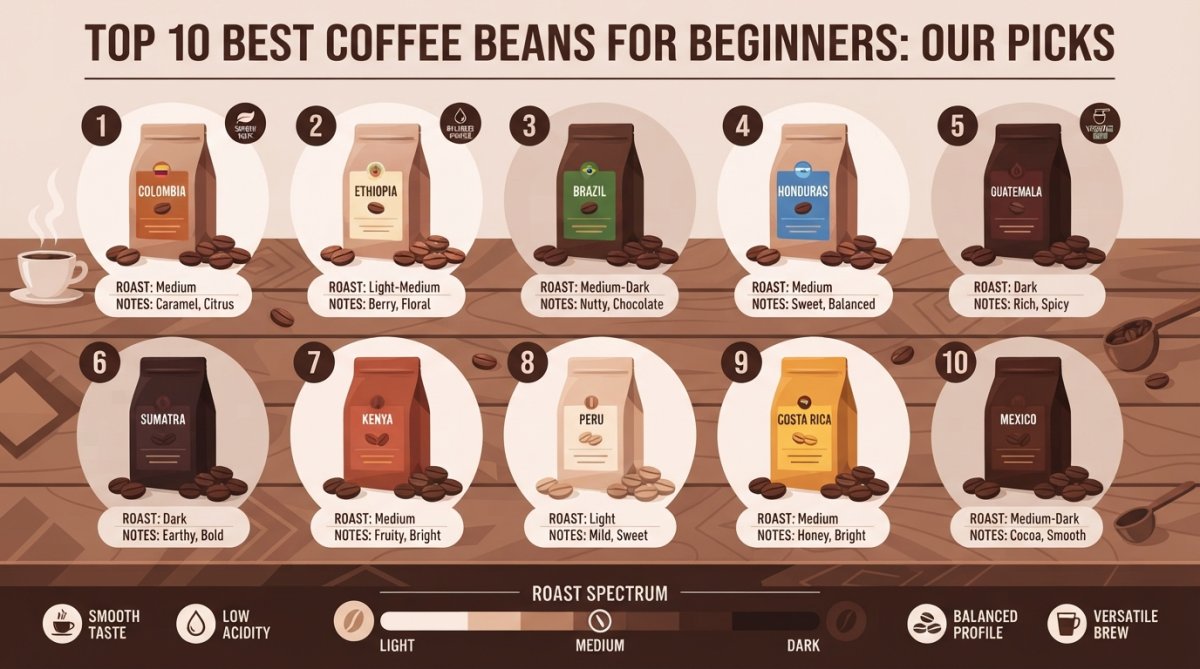
Top 10 Best Coffee Beans for Beginners: Our Picks
1. Brian's Premium Coffee
Brian's Premium Coffee stands out as the top choice for beginners seeking carefully sourced, premium beans without overwhelming complexity. Our medium roasts balance approachability with genuine flavor depth, roasted fresh with a roast date clearly marked on every bag for peak freshness.
What makes Brian's Premium Coffee the best choice for beginners is our philosophy: coffee should bring comfort and warmth to your daily routine while fostering connection. The rich, bold flavor profiles work across brewing methods, from simple drip makers to French press, without requiring advanced technique.
2. Eight O'Clock Coffee The Original Medium Roast
Eight O'Clock's "The Original" is a classic, widely available medium roast made from 100% Arabica beans. It's smooth, well-balanced, and consistently approachable, with sweet and fruity flavor and subtle nutty notes. Eight O'Clock has been roasting since 1859, refining this blend through decades of experience.
The Original costs significantly less per ounce than specialty roasters, making it an excellent budget-friendly entry point. The main limitation is that it's primarily ground coffee; seek out the whole bean version for better freshness.
Best for: Budget-conscious beginners and anyone wanting a reliable, no-fuss daily brew.
3. Lifeboost Coffee Medium Roast
Lifeboost Coffee specializes in single-origin, shade-grown, low-acid beans that are third-party tested for mycotoxins, pesticides, and heavy metals. For beginners with acid reflux or sensitive stomachs, this is a game-changer.
The medium roast delivers smooth, clean flavors without the sharpness that acidity brings. Lifeboost publishes third-party lab results on their website and is USDA Organic certified. The trade-off is price, roughly double what you'd pay for Eight O'Clock, but justified if stomach sensitivity is your concern.
Best for: Beginners with sensitive stomachs or acid reflux concerns.
4. Volcanica Coffee Low Acid Coffee
Volcanica Coffee sources beans from volcanic regions known for naturally lower acidity, including Sumatra Mandheling, Brazil Santos, and Hawaiian Kona. Beans are fresh roasted to order, so you control the roast date.
The variety here is the main appeal. If you're curious about single-origin coffees but intimidated by the choices, Volcanica makes exploration accessible. Pricing is moderate, higher than grocery store brands but lower than many specialty roasters.
Best for: Beginners interested in exploring low-acid, single-origin varieties.
5. Peet's Coffee Major Dickason's Blend
Peet's Major Dickason's Blend is a dark roast that successfully breaks the "medium roast for beginners" rule. It's full-bodied, complex, and bold without being unpleasantly bitter. Peet's has been roasting since 1966 and has earned respect in specialty coffee circles.
Major Dickason's is available in whole bean or ground at most supermarkets and Peet's Coffee locations. The dark roast works exceptionally well with milk and sugar, making it forgiving for beginners still figuring out their preferences.
Best for: Beginners who prefer bold, full-bodied coffee or plan to add milk and sugar.
6. Starbucks Pike Place Roast
Starbucks Pike Place Roast is a medium roast designed to be universally appealing, with notes of cocoa and toasted nuts. It's available everywhere, grocery stores, Starbucks cafes, online, ensuring consistency and convenience.
The advantage is accessibility and reliability. For beginners, this removes friction. The disadvantage is that Pike Place, while decent, isn't exceptional. Coffee enthusiasts often dismiss Starbucks as over-roasted and generic.
Best for: Beginners seeking maximum convenience and consistency.
7. Lavazza Super Crema Whole Bean Coffee
Lavazza Super Crema is a medium roast blend of Arabica and Robusta beans that produces excellent crema (the golden foam on espresso). Notes of hazelnut and brown sugar create a smooth, approachable flavor. It's an Italian-style coffee with European heritage dating to 1895.
Super Crema is ideal if you're planning to buy an espresso machine or already have one. The Robusta component gives body and crema that pure Arabica can't match. For drip or French press, it's still solid and balanced.
Best for: Beginners planning espresso brewing or seeking an Italian-style coffee experience.
8. Stone Street Coffee Cold Brew Reserve
Stone Street Coffee's Cold Brew Reserve is a dark roast specifically optimized for cold brewing. It's low in acidity, smooth, and rich, designed to shine when steeped in cold water rather than hot.
If cold brew is your brewing method, this bean is worth seeking out. The optimization matters, beans chosen for cold brew have different characteristics than those for hot brewing. The trade-off: this bean is less versatile for hot brewing and costs more than mainstream brands.
Best for: Beginners committed to cold brew as their primary brewing method.
9. Roadway Coffee Mexican Medium Roast
Roadway Coffee emphasizes fresh roasting and beginner-friendly selection. Their Mexican Medium Roast features subtle nutty undertones and mild acidity, a gentle introduction to coffee's flavor spectrum.
Roadway explicitly markets to beginners, so their guidance and bean selection are curated with newcomers in mind. The beans are roasted fresh, and shipping is reasonably priced. The limitation is availability, you'll order online rather than grab a bag at the grocery store.
Best for: Beginners who value fresh roasting and don't mind ordering online.
10. Allegro Coffee Organic Espresso Sierra
Allegro Coffee's Organic Espresso Sierra is a medium-dark roast with notes of dark chocolate and caramel. It's organic certified and available primarily through Whole Foods Market. The flavor is rich and layered without being harsh.
Allegro is a solid middle-ground choice, better quality than grocery store brands, more accessible than boutique roasters, and certified organic. The price is higher than mainstream brands, and availability is limited to Whole Foods locations.
Best for: Beginners seeking organic certification and specialty coffee quality without boutique pricing.
Types of Coffee Beans for Beginners: Single-Origin vs. Blends
When learning about coffee, you'll encounter two main categories: single-origin beans and blended beans.
Single-Origin Beans: Exploring Regional Flavors
Single-origin coffee comes from one geographic region, a specific country, farm, or smaller area within a country. Ethiopian Yirgacheffe, Brazilian Santos, and Hawaiian Kona are examples. Single-origin beans showcase terroir: the combination of altitude, climate, soil, and processing method that creates a bean's unique character.
Single-origin beans typically have more pronounced, distinctive flavors. You might detect notes of blueberry in an Ethiopian bean or chocolate in a Brazilian. For beginners, single-origin beans offer a learning opportunity. Tasting a few different origins side-by-side teaches you how geography shapes flavor.
However, single-origin beans can be polarizing. If the origin's flavor profile doesn't match your preference, you've invested in a bag you might not love. They also cost more than blends because they require sourcing from specific farms.
Blended Beans: Consistency and Balance
Blended coffee combines beans from multiple origins, roasted together to create a balanced, consistent flavor. Peet's Major Dickason's Blend and Starbucks Pike Place Roast are blends. Roasters blend beans to achieve specific flavor targets, balancing acidity with body or combining fruity notes with chocolate undertones.
Blends are designed for consistency. A roaster can adjust which origins go into the blend to maintain the same flavor profile year-round. This makes blends reliable and forgiving for beginners. Blends also tend to cost less than single-origin beans.
How to Choose Coffee Beans: Key Factors Every Beginner Should Know
Beyond bean type and roast level, several practical factors determine whether you'll enjoy your coffee purchase.
Check the Roast Date for Freshness
Coffee begins to oxidize and lose flavor immediately after roasting. A roast date tells you exactly how fresh your beans are. Coffee is at peak flavor 5-14 days after roasting and remains drinkable for about 4 weeks, though quality declines over time.
Look for bags labeled with a roast date, not a "best by" date. Grocery store brands often don't list roast dates, which is a red flag. Specialty roasters and online retailers typically list roast dates prominently because freshness is part of their value proposition.
Store your beans in an airtight container away from heat, light, and moisture. Whole beans stay fresh longer than ground coffee. If you have a grinder, buy whole beans and grind just before brewing.
Read Labels for Flavor Notes and Processing Methods
Coffee labels often include tasting notes: "notes of chocolate," "hints of blueberry," "caramel finish." These describe actual flavors you'll experience, determined by origin, roast level, and processing method.
Processing method refers to how the bean was treated after harvest. Natural processing (beans dried in their fruit) creates fruitier, more complex flavors. Washed processing (fruit removed before drying) creates cleaner, brighter flavors. Honey processing (partial fruit removal) lands in the middle. For beginners, washed coffees are often more approachable because they're cleaner.
Consider Ethical Sourcing and Certifications
Coffee is grown in tropical regions, often by small farmers in developing countries. Ethical sourcing ensures farmers are paid fairly and work in safe conditions. Direct trade, fair trade, and rainforest-certified are common labels.
Direct trade means the roaster buys directly from the farmer, ensuring more money reaches the farmer. Fair trade certification guarantees minimum prices and labor standards. For beginners, these certifications aren't essential, but they're worth considering if ethical sourcing matters to you.
Coffee Brewing Methods for Beginners: Matching Beans to Your Equipment
The brewing method you use affects which beans perform best. Different methods extract coffee differently, and certain beans shine in certain setups.
Drip Coffee Makers: Start with Medium Roasts
Drip machines are the most common brewing method in American homes. Water heats and drips through ground coffee, extracting flavor over 5-10 minutes. This moderate extraction time suits medium roasts well.
For drip brewing, use medium roasts from any of the picks above. Grind the beans to medium consistency (like sand). A common mistake is grinding too fine, which causes over-extraction and bitterness. Drip machines are forgiving, even if your technique isn't perfect, a decent medium roast delivers acceptable results.
French Press: Choose Full-Bodied Beans
French press brewing involves steeping coarsely ground coffee in hot water for 4 minutes, then pressing down a metal filter to separate grounds from liquid. This longer contact time extracts more oils and creates a fuller-bodied cup than drip brewing.
For French press, choose beans with body, medium or dark roasts work well. Avoid light roasts, which can taste thin and under-extracted. The Peet's Major Dickason's Blend and Lavazza Super Crema both excel in French press.
Cold Brew: Opt for Dark or Medium Roasts
Cold brew steeps coarsely ground coffee in cold water for 12-24 hours. The long, cool extraction creates a smooth, low-acidity concentrate that you dilute with water or milk.
Dark and medium roasts work best for cold brew because they have the body to stand up to extended steeping. Light roasts can taste thin. Cold brew requires planning ahead, but the process itself is hands-off.
Espresso: Select Beans Labeled for Espresso
Espresso machines force hot water through finely ground coffee under high pressure, extracting a small, concentrated shot in 25-30 seconds. Espresso requires beans with specific characteristics: medium to dark roast, fine grind, and typically a blend for body and crema.
Beans labeled "espresso" are roasted and blended specifically for this method. Lavazza Super Crema is an excellent beginner espresso bean. Avoid light roasts for espresso, as they extract unevenly and taste sour. Espresso machines have a steep learning curve, so start with drip, French press, or cold brew first.
| Brewing Method | Best Roast | Grind Size | Steep Time | Best For |
|---|---|---|---|---|
| Drip | Medium | Medium | 5-10 min | Beginners, daily brewing |
| French Press | Medium-Dark | Coarse | 4 min | Fuller body, more oils |
| Cold Brew | Medium-Dark | Coarse | 12-24 hrs | Low acidity, smooth |
| Espresso | Medium-Dark | Fine | 25-30 sec | Concentrated shots |
Sensory Training for Beginners: Learning to Taste Coffee
Coffee tasting, called cupping, is how professionals evaluate beans. You don't need to be a professional to develop your palate.
Start by tasting the same coffee multiple ways. Brew a cup in a French press, then in a drip machine, and notice how the flavor differs. Taste the same coffee at different temperatures, let it cool for 10 minutes and notice how flavors change.
Try tasting coffee side-by-side with other flavors. If the label says "notes of chocolate," taste a piece of dark chocolate immediately before sipping the coffee. Your brain will make the connection more readily.
Keep a simple tasting journal. Write down what you taste: "bright and fruity," "smooth with chocolate," "bitter and harsh." Over weeks, patterns emerge. Finally, taste coffee from different origins back-to-back. Brew a cup of Brazilian Santos, then Ethiopian Yirgacheffe. The contrast makes differences obvious.
Storage Tips to Keep Your Beans Fresh
Proper storage extends the life of your beans and maintains flavor. Coffee's enemies are heat, light, air, and moisture.
Store beans in an airtight container at room temperature, away from direct sunlight. A kitchen cabinet works well. Avoid the refrigerator, as condensation damages beans and absorbs odors from other foods.
Buy whole beans rather than pre-ground whenever possible. Whole beans stay fresh 2-4 weeks after roasting. Ground coffee stays fresh 3-7 days. Grind beans immediately before brewing, the moment you grind, oxidation accelerates.
If you buy in bulk, freeze extra beans in an airtight, freezer-safe container. Properly frozen beans stay fresh for several months. Thaw at room temperature before opening to avoid condensation.
Finding the best coffee beans for beginners comes down to understanding your preferences and choosing beans that match your brewing method. Start with medium roasts from reputable roasters, they're forgiving, approachable, and work across brewing methods. As your palate develops, explore single-origin beans and different roast levels to discover what truly excites you.
At Brian's Premium Coffee, we believe the ritual of coffee matters as much as the flavor. Our carefully sourced premium coffee beans are roasted fresh and designed to bring comfort and warmth to your daily routine. Whether you're brewing your first cup or your thousandth, we invite you to slow down, savor the moment, and experience coffee that encourages genuine connection. Explore our collection of rich, bold flavor profiles and discover the beans that resonate with you.
Frequently Asked Questions
What roast level is best for beginners drinking coffee?
Medium roast is generally the best starting point for beginners. It offers a balanced flavor profile that's neither too acidic nor too bitter, making it approachable for new drinkers. Medium roasts like Eight O'Clock Coffee The Original or Starbucks Pike Place Roast deliver smooth, well-rounded taste without overwhelming the palate. Light roasts can be more complex and acidic, while dark roasts may taste too intense for those just starting their coffee journey.
Should I choose single-origin or blend coffee beans as a beginner?
Blended coffee beans are typically better for beginners because they offer consistent, balanced flavor profiles designed to appeal to a broad audience. Blends combine beans from different regions to create smoothness and predictability. Single-origin beans showcase unique regional characteristics and flavor notes that require more developed palates to appreciate. Once you've explored blends and understand your preferences, single-origin coffees like Ethiopian Yirgacheffe or Brazilian Santos become more rewarding.
How do I know if coffee beans are fresh when ordering online?
Always check the roast date on the bag, this is the most reliable freshness indicator. Beans are optimal for consumption within 2-4 weeks of roasting. When ordering online, look for companies that list a recent roast date and offer subscription options ensuring regular shipments. Reputable brands like Lifeboost and Stone Street Coffee prioritize freshness by roasting to order. Avoid bags without visible roast dates, and choose retailers that ship quickly to minimize staleness during transit.
What are the best coffee beans for making cold brew as a beginner?
Dark and medium roasts work best for cold brew because the extended steeping time (12-24 hours) extracts flavors effectively. Stone Street Coffee Cold Brew Reserve is specifically formulated for this method and offers low acidity with smooth, rich flavor. Avoid light roasts for cold brew, as they can taste under-extracted and sour. When selecting beans for cold brew, look for coarse-ground options or whole beans you can grind yourself, and choose varieties labeled as low-acid to ensure a smooth final cup.
How do I verify that coffee beans are ethically sourced?
Look for certification labels on the bag such as Fair Trade, Direct Trade, Rainforest Alliance, or USDA Organic. These certifications indicate that beans were sourced responsibly and meet specific environmental and social standards. Brands like Lifeboost provide third-party testing transparency, while many specialty roasters detail their sourcing practices on their websites. Check the company's website for information about farmer relationships and supply chain practices. Reputable brands are transparent about their sourcing methods and happy to provide documentation upon request.
This article was written using GrandRanker