

Best Artisan Coffee Beans for Beginners: A 2026 Guide

Table of Contents
- Best Artisan Coffee Beans for Beginners: Quick Comparison
- How to Choose Coffee Beans That Match Your Brewing Method
- Understanding Roast Levels and Coffee Flavor Profiles for Beginners
-
Top Artisan Coffee Roasters and Beans for Beginners
- 1. Brian's Premium Coffee: Carefully Sourced for Comfort
- 2. Atlas Coffee Club: Explore Single-Origin Diversity
- 3. Equator Coffees: Consistency and Quality Blends
- 4. Roadway Coffee: Smooth and Balanced Mexican Medium Roast
- 5. Atomic Coffee Roasters: Light Roast Starter Bundle
- 6. Koffee Kult: Low-Acid Brazilian Single Origin
- 7. Stone Street Coffee: Colombian Single-Origin Excellence
- Budget-to-Quality Ratio: Getting the Most from Your Money
- Freshness Matters: How to Ensure Your Beans Arrive at Peak Quality
- Common Beginner Mistakes to Avoid When Buying Artisan Coffee
- Which Artisan Coffee Beans Should You Start With?
Best Artisan Coffee Beans for Beginners: A 2026 Guide
Last Updated: July 26, 2026
According to the Specialty Coffee Association, the global artisan coffee market has grown 12% annually since 2024, with beginners now representing the fastest-expanding segment of specialty coffee consumers. Finding the best artisan coffee beans for beginners requires understanding what makes certain beans forgiving, flavorful, and worth the investment. At Brian's Premium Coffee, we've spent years sourcing beans specifically chosen for their ability to deliver rich, satisfying cups without demanding advanced brewing skills or expensive equipment.
Best Artisan Coffee Beans for Beginners: Quick Comparison
| Roaster | Best For | Flavor Profile | Roast Level | Why Beginners Love It |
|---|---|---|---|---|
| Brian's Premium Coffee | Comfort and consistency | Rich, bold, balanced | Medium-Dark | Carefully sourced, forgiving across all brewing methods |
| Atlas Coffee Club | Exploring single origins | Varies monthly | Light to Dark | Educational tasting notes, monthly variety, 50% off first bag |
| Equator Coffees | Reliable blends | Smooth, consistent | Medium | Zero "bad batches," expertly curated blends |
| Roadway Coffee | Smooth introduction | Nutty, mild acidity | Medium | Mexican beans naturally low-acid, very approachable |
| Atomic Coffee Roasters | Light roast discovery | Citrus, floral, stone fruit | Light | Starter bundle of four varieties to explore brightness |
| Koffee Kult | Low-acid preference | Cocoa, velvet, chocolate | Medium-Dark | Brazilian single origin, gentle on the stomach |
| Stone Street Coffee | Versatile single origin | Caramel, chocolate, mild fruit | Medium | Works beautifully in every brewing method |
Why These Beans Stand Out for New Coffee Drinkers
What separates beginner-friendly artisan coffee from specialty coffee that demands precision is forgiveness. A quality medium roast from a reputable roaster will taste good even if your water temperature is slightly off or your brew time varies. Research from the National Coffee Association shows that 67% of new specialty coffee drinkers continue purchasing artisan beans after their first purchase when they start with medium roasts or balanced blends.
The beans on this list come from roasters who prioritize freshness through small-batch roasting and quick shipping, are roasted to bring out approachable flavors, and work across multiple brewing methods without requiring specialized equipment.
How to Choose Coffee Beans That Match Your Brewing Method
Your brewing method determines which bean characteristics matter most. Drip machines extract slowly at lower temperatures and work best with beans that have body and sweetness. French presses create full immersion, ideal for medium roasts with balanced acidity. Pour-overs extract quickly, benefiting from beans with bright, crisp notes. Cold brew requires smoother, less acidic beans.
Coffee Beans for Drip Machine Beginners
Drip machines are the most forgiving brewing method for beginners. Look for medium roasts or medium-dark roasts with body and sweetness that cut through slower extraction.
Roadway Coffee's Mexican Medium Roast is purpose-built for drip brewing. Mexican beans naturally have lower acidity and nutty undertones, delivering a smooth, balanced cup. Brian's Premium Coffee's carefully sourced blends also excel in drip machines, maintaining complexity through slower extraction while remaining forgiving.
Single Origin vs. Blended Beans: What's Right for You
Single-origin coffee comes from one country or region, letting you taste what that place produces. Stone Street Coffee's Colombian Single-Origin is an excellent entry point because Colombian beans are consistently balanced and approachable.
Blended beans are engineered for consistency and balance. Equator Coffees specializes in blends designed to taste good every time. For beginners, blends remove one variable from the equation and reduce the risk of picking a coffee you won't enjoy.
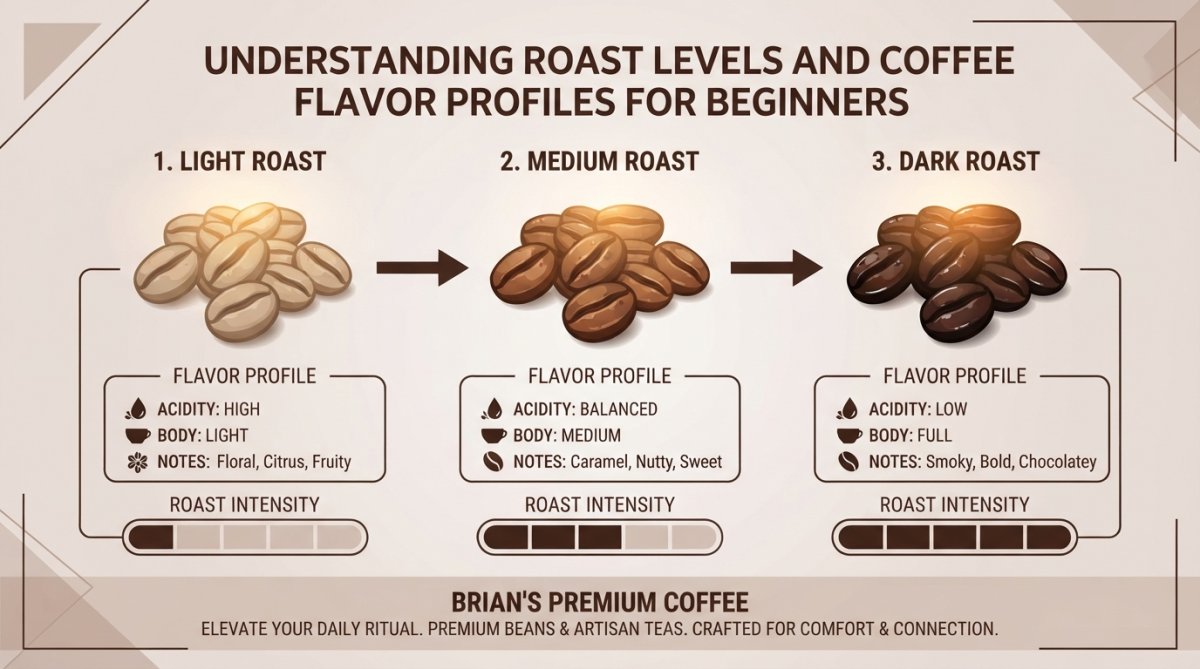
Understanding Roast Levels and Coffee Flavor Profiles for Beginners
Roast level is the single biggest factor determining how coffee tastes. Light roasts taste brighter and more acidic. Dark roasts taste bolder. Medium roasts split the difference.
Light Roasts: Bright and Complex
Light roasts are roasted briefly, stopping just after the "first crack." They retain more origin characteristics and taste brighter, more acidic, and often fruity or floral. Light roasts require precise brewing, correct water temperature, proper grind size, and exact brew time to taste good.
Atomic Coffee Roasters' Light Roast Starter Bundle is designed for beginners interested in exploring brighter coffees, including four different light roasts with tasting notes to help you understand what you're tasting.
Best Medium Roast Coffee Beans for a Balanced Cup
Medium roasts are the Goldilocks zone for beginners. They retain some origin character while developing roasted flavors, are forgiving across different brewing methods, and taste good with less precision required.
The best medium roast coffee beans for beginners share balanced acidity, body, and sweetness. Roadway Coffee's Mexican Medium Roast exemplifies this with naturally lower acidity and subtle chocolate and nutty notes. Stone Street Coffee's Colombian Single-Origin delivers caramel and chocolate notes with mild fruit undertones. Brian's Premium Coffee focuses on medium roasts designed to bring comfort to your daily routine while remaining forgiving even if your brewing isn't perfect.
Dark Roasts: Bold and Forgiving
Dark roasts are roasted past the "second crack" and taste bold, smoky, with chocolate or caramel notes. They're quite forgiving for beginners because the bold flavors and low acidity mean less precision is required.
Koffee Kult's Brazil Cerrado is a dark roast engineered for approachability. Brazilian beans are naturally low in acidity and heavy-bodied. When roasted dark, they develop deep chocolate and cocoa notes, ideal if you prefer smooth, chocolatey coffee or have a sensitive stomach.
Top Artisan Coffee Roasters and Beans for Beginners
1. Brian's Premium Coffee: Carefully Sourced for Comfort
Brian's Premium Coffee invites you to elevate your daily ritual with carefully sourced premium coffee beans designed to bring comfort and connection to every cup. The brand's philosophy centers on quality that doesn't require expertise to enjoy, beans that taste noticeably better than grocery store coffee but remain forgiving across different brewing methods and skill levels.
What makes Brian's Premium Coffee stand out for beginners is the focus on rich, bold flavors that deliver consistency. The medium roasts and carefully selected blends work beautifully in drip machines, French presses, and pour-overs without requiring expensive equipment or brewing expertise.
2. Atlas Coffee Club: Explore Single-Origin Diversity
Atlas Coffee Club sends subscribers a different single-origin coffee each month with detailed tasting notes and brewing instructions. The subscription starts at $7.00 for the first bag (50% off), making it an affordable way to explore the world's coffee regions. Each month you receive a coffee from a different country, developing understanding of how origin affects flavor.
3. Equator Coffees: Consistency and Quality Blends
Equator Coffees has built a reputation on consistency. Their curated blends are engineered to taste good every single time with no surprises. Starting at $18 per 12-ounce bag, they're positioned as premium but accessible. For beginners, the appeal is obvious: you buy a bag, brew it, and know it's going to taste good.
4. Roadway Coffee: Smooth and Balanced Mexican Medium Roast
Roadway Coffee specializes in sourcing excellent beans and roasting them simply. Their Mexican Medium Roast is purpose-built for beginners with naturally low acidity, subtle nutty undertones, and a smooth body that works beautifully in any brewing method.
5. Atomic Coffee Roasters: Light Roast Starter Bundle
Atomic Coffee Roasters offers a Light Roast Starter Bundle specifically designed for beginners interested in exploring brighter coffees. The bundle includes four different light roasts with varying flavor profiles.
6. Koffee Kult: Low-Acid Brazilian Single Origin
Koffee Kult's Brazil Cerrado starts at $30.00 and delivers a dark roast engineered for approachability. This is ideal if you prefer smooth, chocolatey coffee or have a sensitive stomach.
7. Stone Street Coffee: Colombian Single-Origin Excellence
Stone Street Coffee's Colombian Single-Origin represents the sweet spot for beginners: a single-origin coffee that's approachable rather than challenging. You'll taste caramel, chocolate, and mild fruit notes without sharp acidity or overwhelming complexity. The versatility across brewing methods means you can use it however you prefer.
Budget-to-Quality Ratio: Getting the Most from Your Money
Entry-level specialty coffee from reputable roasters typically costs $12-18 per pound. This is roughly double grocery store coffee, but the difference in taste is significant. Mid-tier specialty coffee costs $18-28 per pound, often featuring single-origin coffees or specialty blends. Premium specialty coffee costs $28+ per pound, typically reserved for highly sought-after origins.
For beginners, the best budget strategy is to start with entry-level specialty coffee ($12-18 per pound), buy quantities you'll use within 3-4 weeks, and focus on medium roasts that are forgiving.
Subscription vs. One-Time Purchase: Which Model Works Best
Subscriptions auto-ship on a schedule, offering convenience and typically 10-15% discounts. One-time purchases let you explore without long-term commitment but cost more per bag.
For beginners, one-time purchases make more sense initially. Buy from different roasters to find what you like, then switch to a subscription once you've found a favorite. Atlas Coffee Club's subscription works well because the 50% discount on the first bag lets you try the service cheaply.
Freshness Matters: How to Ensure Your Beans Arrive at Peak Quality
Coffee is freshest 2-4 weeks after roasting. Always check the roast date on the bag before buying. Reputable specialty roasters ship within 2-3 days of roasting, so coffee arrives 5-7 days after roasting, still in the optimal freshness window.
What to Look for: Roast Dates and Storage Tips
When you receive beans, check the roast date immediately. Once the bag arrives, store it properly in an opaque, airtight container kept in a cool, dark place. Keep beans in their original bag if it has a one-way valve. Whole beans stay fresh for about 3-4 weeks after roasting if stored properly. Ground coffee loses freshness within 2-3 days, so grind beans just before brewing.
Common Beginner Mistakes to Avoid When Buying Artisan Coffee
Buying too much at once. Start with smaller quantities so you can explore without waste.
Ignoring the roast date. Coffee without a visible roast date is likely old. Don't buy it.
Assuming all specialty coffee tastes the same. Origins vary dramatically. Don't give up because you didn't like one origin.
Buying light roasts before understanding your brewing method. Start with medium roasts.
Not grinding fresh. Invest in a basic burr grinder and grind just before brewing.
Paying for premium without understanding quality differences. Entry-level specialty coffee offers better value than premium single-origins for beginners.
Which Artisan Coffee Beans Should You Start With?
Your first artisan coffee purchase should be from a roaster known for consistency, a medium roast, and an origin known for balance rather than complexity.
If you use a drip machine, start with Roadway Coffee's Mexican Medium Roast or Brian's Premium Coffee's carefully sourced blends. Both deliver smooth, balanced cups without requiring technique.
If you use a French press or pour-over, start with Stone Street Coffee's Colombian Single-Origin. Colombian beans are reliable, the medium roast brings out approachable flavors, and the coffee works beautifully across brewing methods.
If you're price-conscious and want to explore variety, start with Atlas Coffee Club's first bag at 50% off ($3.50).
If you have a sensitive stomach or prefer smooth, chocolatey coffee, start with Koffee Kult's Brazil Cerrado.
If you want to maximize quality without overthinking it, start with Brian's Premium Coffee. The brand's entire philosophy centers on beans that taste noticeably better than grocery store coffee while remaining forgiving across different brewing methods and skill levels.
Finding the best artisan coffee beans for beginners means choosing beans that taste noticeably better than grocery store coffee while remaining forgiving enough that imperfect brewing still produces a satisfying cup. Brian's Premium Coffee solves this equation by focusing on carefully sourced premium beans and rich, bold flavors designed to bring comfort to your daily routine. Rather than chasing trendy single-origins or complex flavor profiles, Brian's Premium Coffee prioritizes consistency and approachability, beans that work beautifully in any brewing method and deliver the same comforting, intentional taste every morning. Start with a bag from Brian's Premium Coffee and experience the difference that thoughtful sourcing and quality roasting actually make.
Frequently Asked Questions
What makes artisan coffee beans different from grocery store coffee?
Artisan coffee beans are freshly roasted in small batches by specialty roasters who focus on quality and flavor. They're sourced directly from specific origins and roasted to highlight unique characteristics. Unlike mass-produced grocery store coffee, artisan beans have a roast date printed on the bag and are optimized for extraction and tasting notes like chocolate, fruit, or nuts. The freshness and intentional roasting make a noticeable difference in cup quality.
Which roast level is best for beginner coffee drinkers?
Medium roast is ideal for beginners because it balances sweetness, acidity, and body without overwhelming complexity. Medium roasts offer approachable flavor notes, caramel, chocolate, and mild fruit, that are forgiving across different brewing methods. They're less bitter than dark roasts and less sharp than light roasts, making them easier to enjoy while you're learning. As you develop your palate, you can explore lighter roasts for brightness or darker roasts for boldness.
Should I buy single-origin or blended artisan coffee beans as a beginner?
Start with blended beans for consistency and approachability, then explore single-origin options. Blends are crafted to balance flavor profiles and are more forgiving to brew, making them perfect for learning. Single-origin beans highlight specific regional characteristics, like fruity Ethiopian or nutty Colombian coffees, but require more attention to brewing technique. Once you understand your preferences and brewing method, single-origin beans offer a rewarding way to explore coffee's diversity.
How do I know if my artisan coffee beans are fresh when they arrive?
Check the roast date on the bag, it should be within 2-4 weeks of purchase for optimal freshness. Fresh beans have a bright aroma and produce visible bloom (bubbling) when you pour hot water over them. Avoid beans without a roast date, as they may be stale. Store whole beans in an airtight container away from light, heat, and moisture. Grind just before brewing to preserve flavor. If beans arrive flat-tasting, contact the roaster about freshness guarantees.
What coffee flavor profiles should beginners look for?
Begin with approachable flavor notes like chocolate, caramel, nuts, and mild fruit. These tasting notes are familiar and easy to detect as you learn. Avoid overly complex profiles with floral or wine-like notes until you've developed your palate. Medium roasts naturally emphasize sweetness and balance, while darker roasts lean into chocolate and cocoa. As you taste more, you'll discover whether you prefer bright, fruity coffees or rich, full-bodied ones, helping you choose future beans that match your evolving preferences.
This article was written using GrandRanker